
Estimated reading time: 10 minutes
We Thought We Were Walking Into an Energy Audit.
We Walked Into a Building That Had Forgotten How to Think.
A commercial office building in Sydney had already invested heavily in a sophisticated Building Management System, energy meters, trend logs and modern HVAC equipment. Yet after only a few hours on site, it became clear the problem wasn’t the technology—it was that nobody was listening to what the building had been trying to say for years.
WR8Tech War Story
Based on a real commercial building. Client details have been changed to protect confidentiality.

Every Building Has a Story
One of the things we’ve learnt over many years working with commercial buildings is that they almost never tell you what’s wrong immediately.
Instead, they leave clues. Sometimes those clues are obvious. A failed motor. A noisy bearing. A leaking valve. More often, they’re much quieter. A trend log that nobody has opened for years. A chiller running on a cool winter morning. A heating valve that’s still 30% open when the room is already warm.
A Building Management System quietly doing exactly what it was told to do—just not what the building actually needs.
This story started with what was supposed to be a routine Building Management System audit for a commercial office building in Sydney. The client wanted to know one thing.
“Can this building be made more energy efficient?”
They expected a list of recommendations. What they received was something very different.
First Impressions
The building itself wasn’t unusual.
Commercial office space. Multiple tenants. Retail. A gym. Central chilled water plant. Heating hot water. Air handling units. Hundreds of fan coil units. Modern Building Management System. Energy meters. Variable Speed Drives. Trend logging. On paper, it looked like a reasonably sophisticated building.
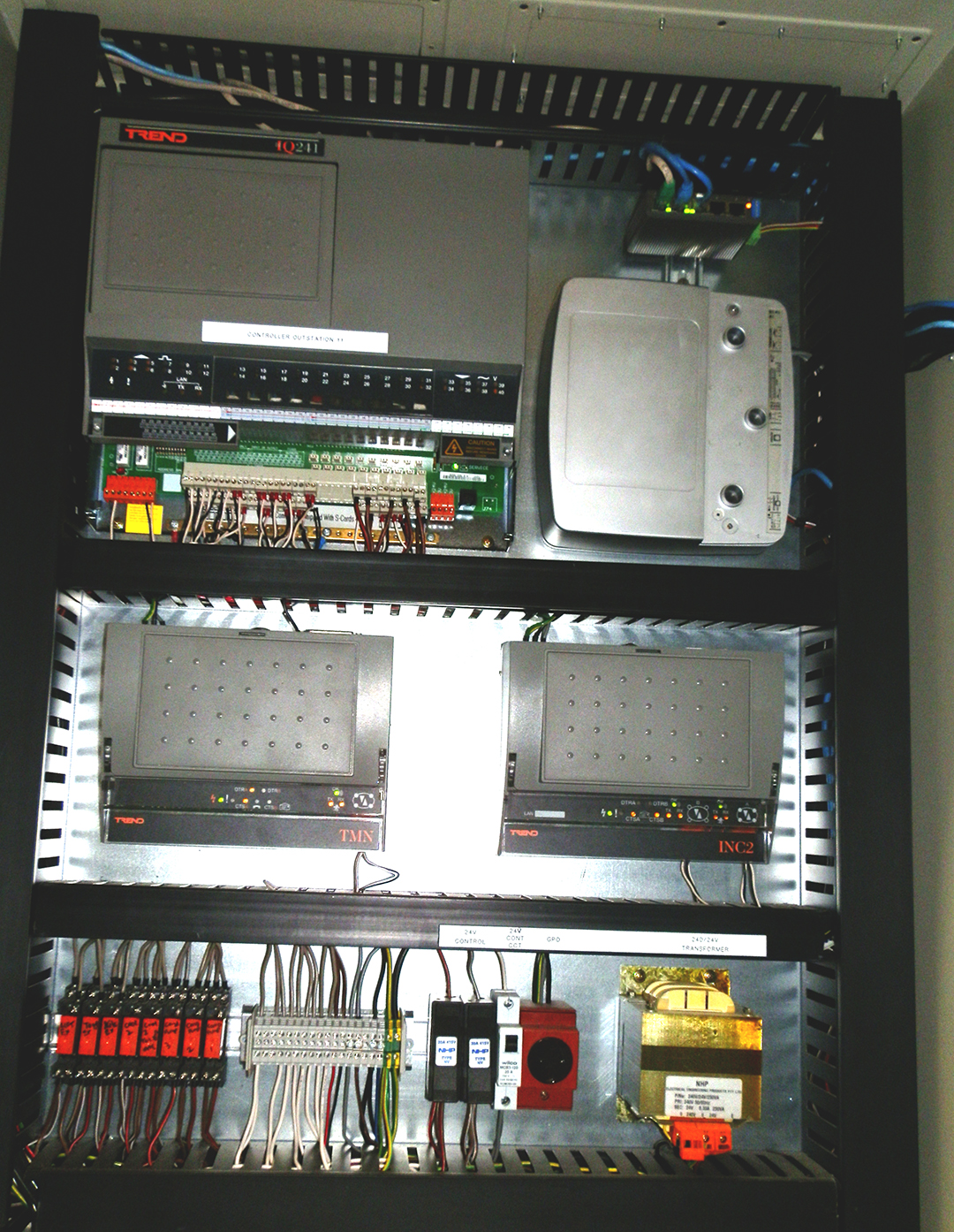
Walking through the plant rooms, nothing immediately suggested disaster. The equipment wasn’t falling apart. The controls cabinet was tidy. The graphics looked acceptable.
In fact, many people would probably have walked away believing everything was working reasonably well.
But experience teaches you not to trust first impressions. The first question is never,
“Does everything run?”
It’s,
“Why is it running?”
That question changes everything.
The Chillers Told the First Story
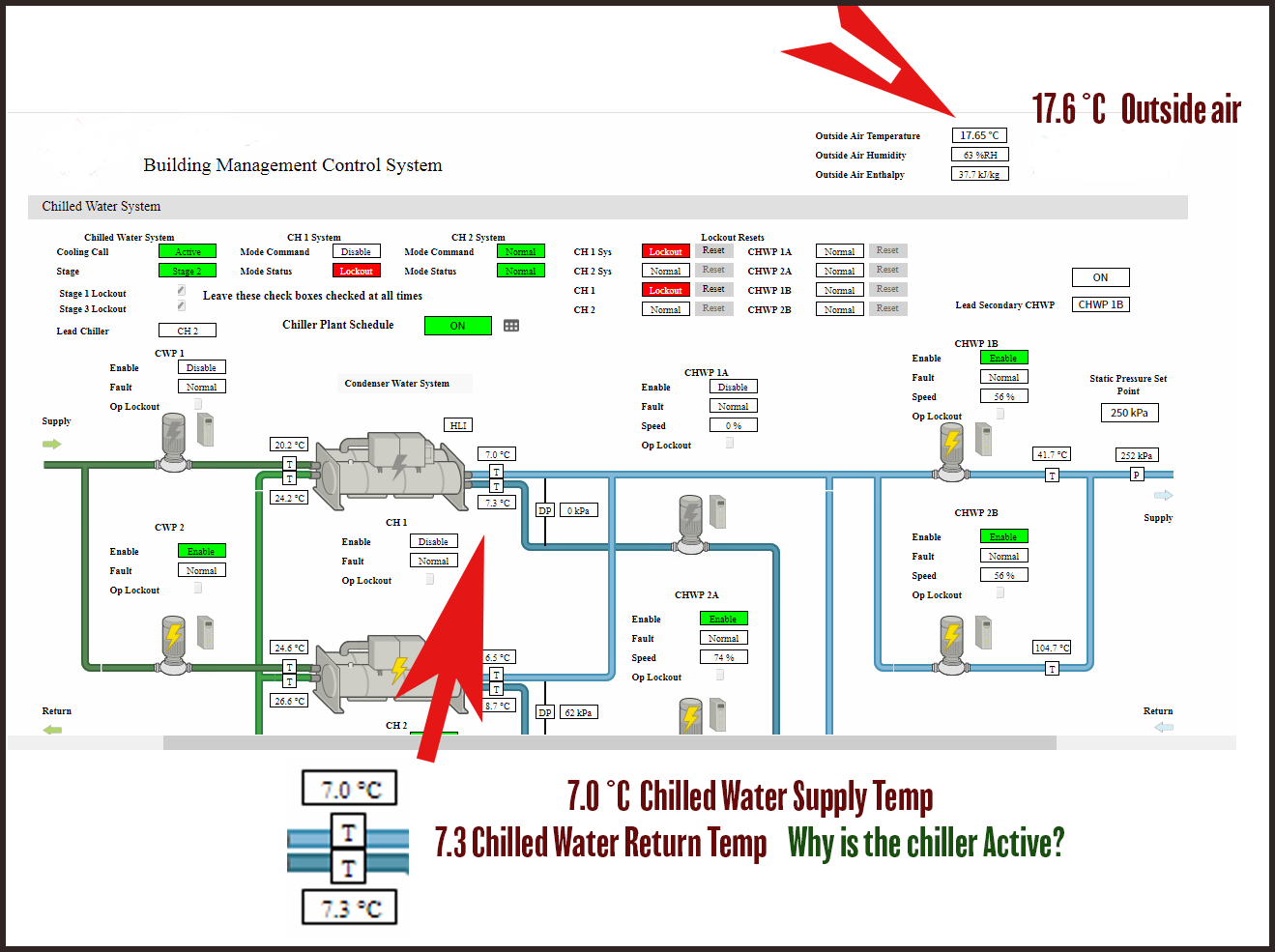
The outside temperature that morning was around 17°C.
Comfortable. Cool enough that many commercial buildings could satisfy much of their cooling demand using outside air. Yet both chillers were available. One was operating. The Building Management System appeared happy. Nobody had raised an alarm. Nothing looked obviously wrong. But looking a little deeper raised an obvious question.
Why was the building manufacturing chilled water when the atmosphere outside was already providing free cooling?
The answer wasn’t obvious. It rarely is. The investigation continued.
Following the Evidence
One of the biggest mistakes people make when investigating a Building Management System is looking at individual pieces of equipment in isolation.
Buildings don’t work like that. Everything is connected. A chiller doesn’t decide to start by itself. Somewhere, something asked for cooling. The question became…
Who?
The Gym Nobody Was Watching
As we continued through the graphics and schedules, one tenant kept appearing.
Large gyms create very different air-conditioning demands to a normal office. Long operating hours. Large internal heat loads. High occupancy. Different comfort expectations. Nothing unusual there. What became interesting was how much influence that tenancy appeared to have over the entire chilled water system.
Rather than operating independently, there were signs the gym could potentially be driving landlord plant far beyond what was actually necessary. If true, that meant one tenancy might be influencing the operating cost of an entire commercial building. Not because anyone had designed it that way. Simply because nobody had revisited the control strategy since the system was commissioned years earlier.
That single discovery justified the entire audit.

Then We Opened the Trend Logs
This is where the investigation became interesting.
Many buildings have trend logs. Very few people actually use them.
Trend logs are the closest thing a building has to a diary. Every valve movement. Every temperature. Every start. Every stop. Every control decision. Recorded. Waiting. Patiently. Unfortunately, many trend logs are never reviewed. Some weren’t even functioning correctly.
Others had been created years earlier but no longer served any useful purpose. But the ones that were working revealed something fascinating.
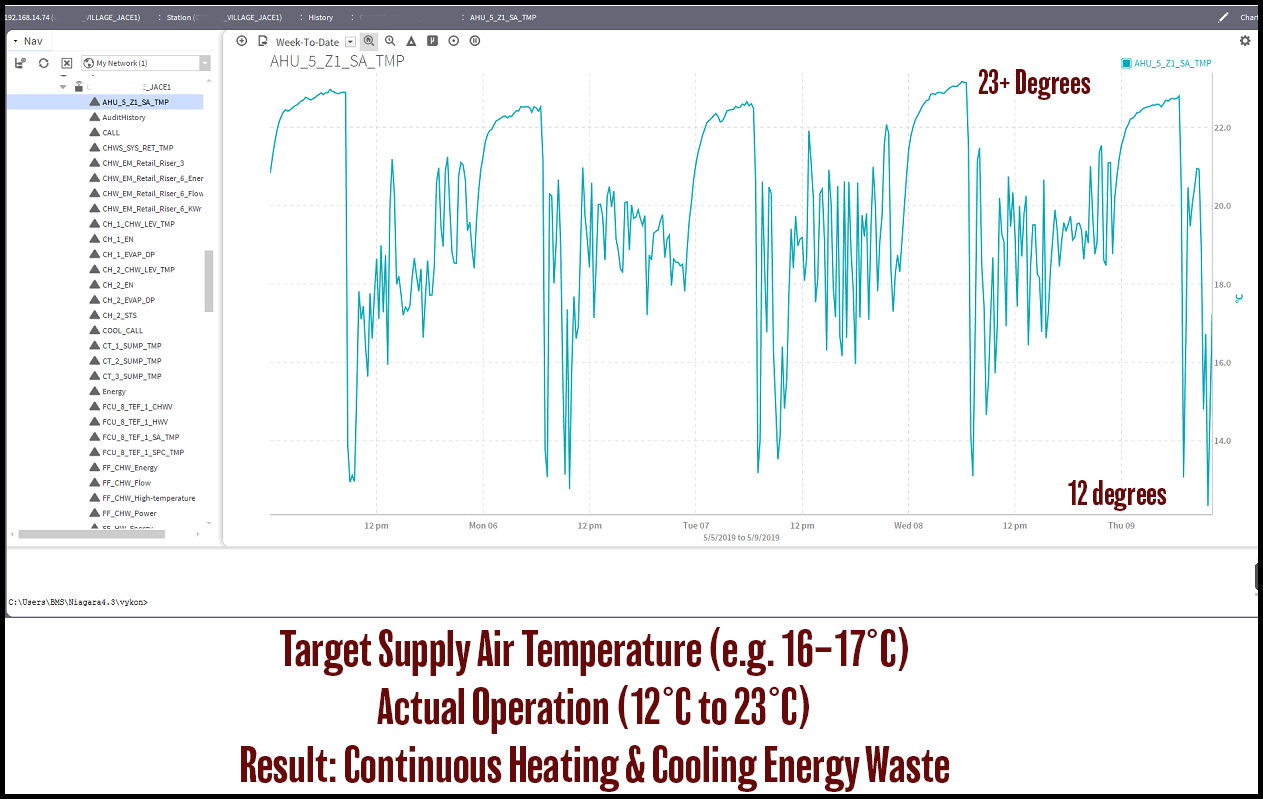
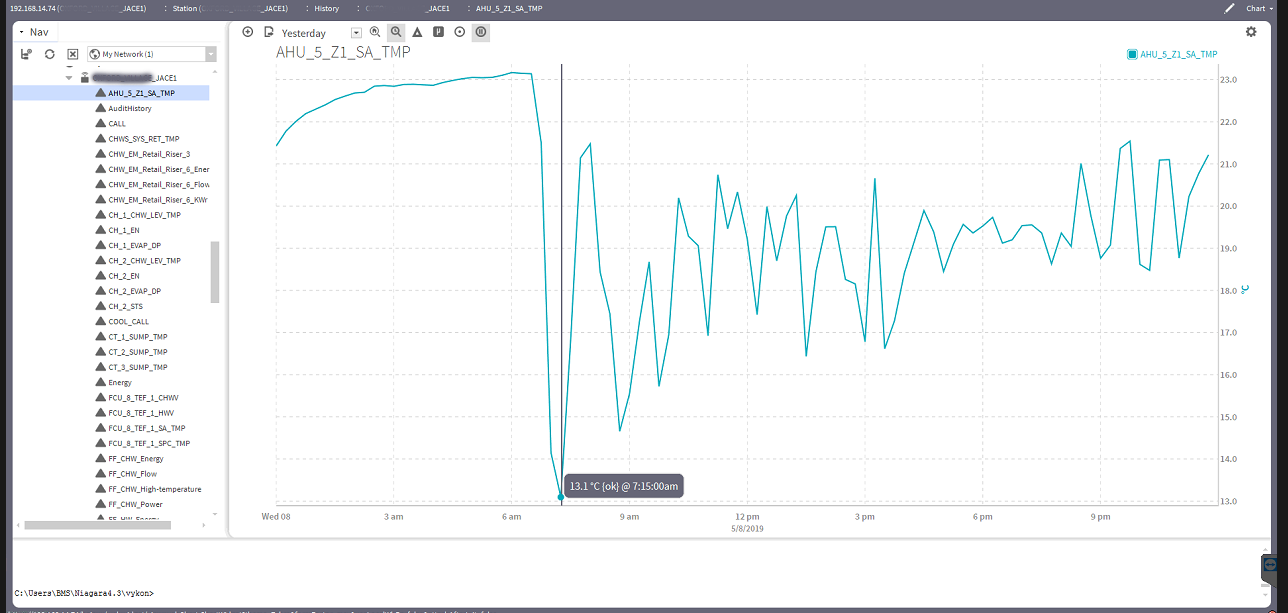
One Air Handling Unit showed its supply air temperature crashing dramatically each morning before hunting for stability throughout the day.
To someone unfamiliar with control systems, it simply looked like another graph. To a controls engineer, it suggested something very different.
Poorly tuned PID control. Overshoot. Valve instability.
Unnecessary chiller demand. Every oscillation represented energy. Every unnecessary degree of cooling eventually appeared on somebody’s electricity bill.
The building had been recording the evidence for years. Nobody had asked it the right questions.
The Building Was Fighting Itself
The further we investigated, the more examples emerged.
Heating and cooling operating closer together than they should. Deadbands inconsistent between systems. Some graphics showing useful control parameters. Others hiding them completely.
Valves demanding maintenance. Trend logs needing repair. Control strategies never fully completed. None of these issues were individually catastrophic.
Collectively, however, they explained why the building struggled to operate efficiently. Nothing major was broken. The building simply wasn’t being driven properly.
The Energy Meters That Nobody Was Reading
One moment still makes me smile.
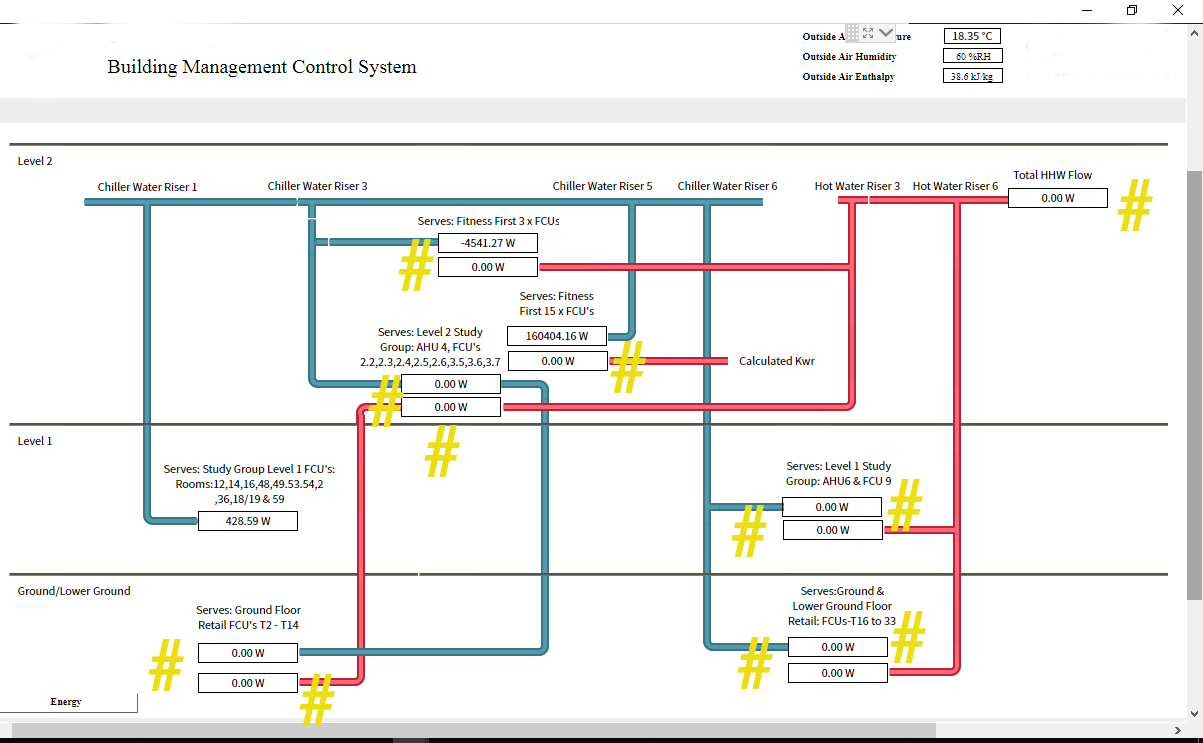
The building had invested in multiple fluid energy meters. Excellent equipment. Proper installation. Integrated into the Building Management System. Exactly what we’d encourage.
Yet many values sat quietly displaying zeros. The information existed. The hardware existed. The communications existed. Nobody had turned that information into knowledge.
It was like installing a speedometer in a car and never looking at it again.
The building wasn’t short of data. It was short of curiosity.
The Biggest Surprise
Clients often expect consultants to recommend replacing systems.
We didn’t.
In fact, one of our strongest recommendations was exactly the opposite. Don’t replace the Building Management System. Recommission it. Improve it. Understand it. Use it. The controllers were still capable. The graphics could be improved. The trend logs expanded. The control strategies refined.
The equipment already contained enormous untapped value. Replacing it would have solved very little.
Driving it properly would solve a great deal.
Fluid Energy Metering
We can see in the BMS graphic, above, the fluid energy meters, they are noted with a yellow “#”.
Buildings Remember
One lesson has stayed with me ever since this project.
Buildings remember everything. Every decision. Every modification. Every shortcut. Every contractor. Every tenant fit-out.
Every temporary override that quietly became permanent. The Building Management System remembers it all. If someone knows how to read the evidence.
What We Recommended
Rather than expensive capital replacement, we recommended recommissioning.
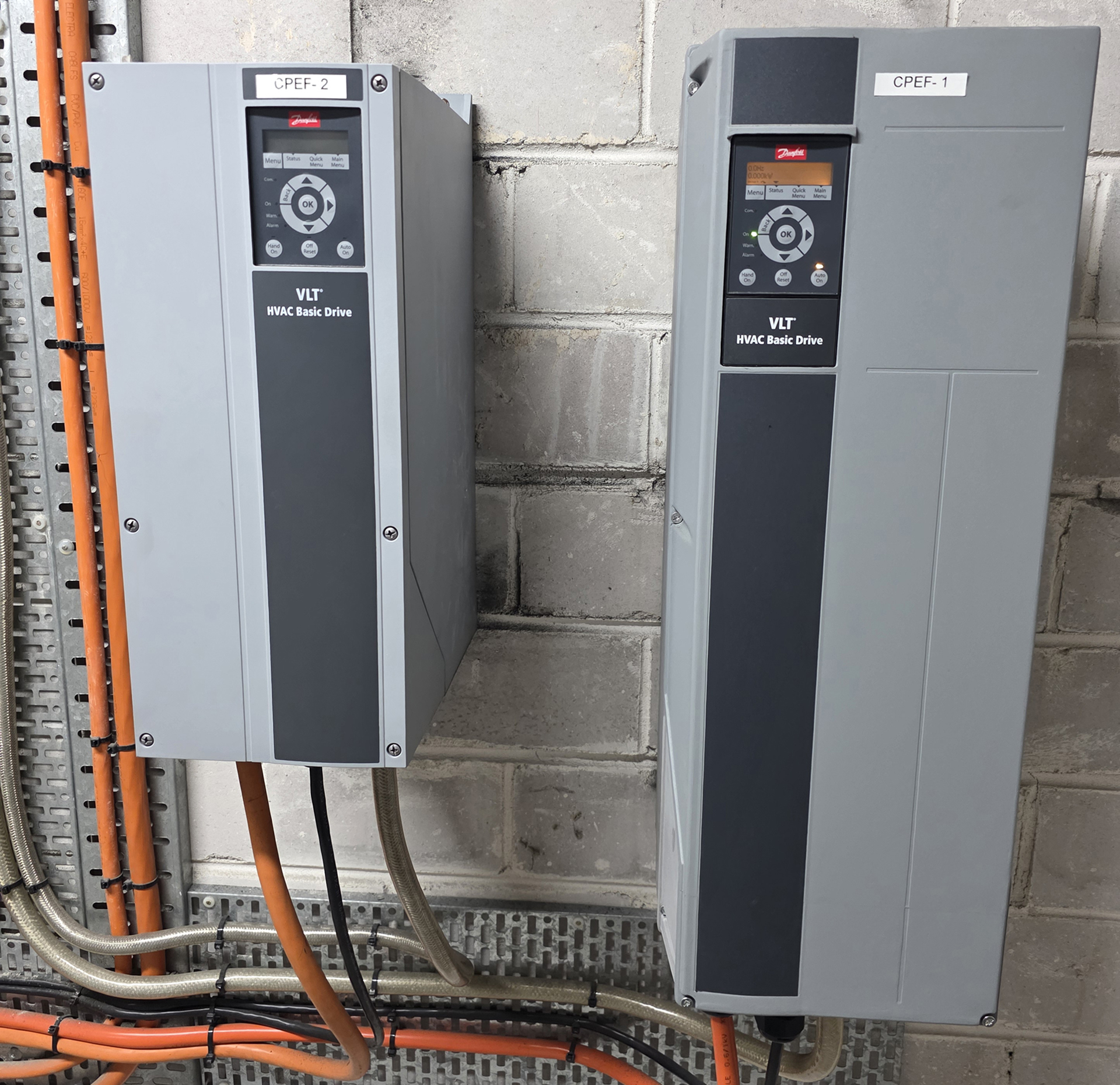
Reviewing the control logic. Testing every major valve. Checking full actuator travel. Improving chiller sequencing. Reviewing boiler lockouts. Repairing trend logs. Connecting high-level interfaces. Making energy meters useful. Improving graphics. Giving operators better visibility.
Most importantly…
Teaching the building to work as one system again.
What We Eventually Learned
This project reinforced something we’ve seen many times since.Commercial buildings rarely waste energy because they’re old.They waste energy because the knowledge slowly disappears.
People move on. Contractors change. Control strategies evolve. Temporary fixes become permanent. Documentation gets lost. Eventually nobody remembers why the Building Management System behaves the way it does.
Years later, someone assumes the system is obsolete. In reality, it has simply been left without direction.
The Hidden Asset
The most valuable asset inside many commercial buildings isn’t the chiller.
It isn’t the boiler. It isn’t even the Building Management System. It’s the knowledge required to make all those systems work together.
When that knowledge disappears, buildings slowly become less efficient, less predictable and more expensive to operate. Recovering that knowledge often costs far less than replacing the equipment.


Final Thoughts
This building didn’t need a new Building Management System.
It needed someone prepared to ask better questions. By the end of the inspection, we hadn’t solved every problem.
What we had done was uncover enough evidence to show there was significantly more value hidden inside the existing Building Management System than anyone realised.
That’s one of the reasons WR8Tech exists. Not simply to repair commercial buildings. But to rediscover the knowledge already sitting inside them. Sometimes, the answers have been there all along.
Continue the Investigation
This project uncovered far more than one isolated issue. Like many commercial buildings, every discovery led to another question. The following WR8Tech War Stories explore similar investigations where seemingly unrelated problems revealed much larger opportunities for improving building performance.
The Hotel That Wanted a $24,000 BMS Upgrade (But Didn’t Need One)
Sometimes the most expensive recommendation isn’t the right one. This investigation showed how understanding an existing Building Management System can avoid unnecessary capital expenditure.
The Fire System That Stopped Talking to the Air Conditioning
A routine Annual Fire Safety Statement test exposed a breakdown in the integration between two critical building systems, demonstrating why system interfaces need ongoing verification.
The Car Park That Passed Every Test but Still Filled with Carbon Monoxide
On paper, the car park ventilation system appeared compliant. In reality, poor control strategies and years of lost building knowledge meant occupants were relying on luck rather than good engineering.
The Building That Was Heating and Cooling at the Same Time
One of the most common and expensive control problems we encounter. Poor PID tuning, inadequate dead bands and competing heating and cooling systems quietly waste energy every day.